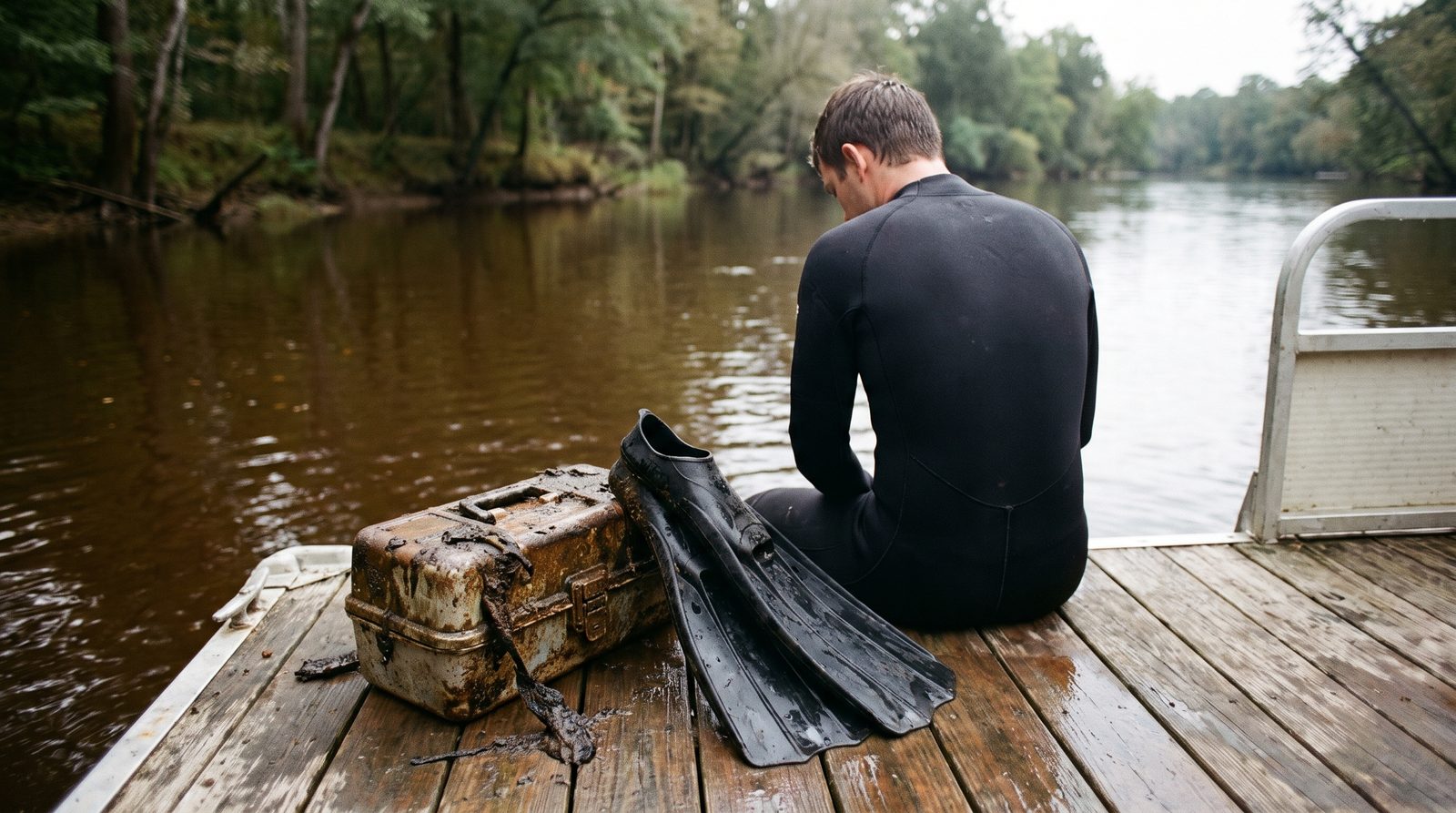
The volunteer divers who search Wisconsin rivers for lost belongings
They are not looking for bodies. That work belongs to the sheriff's dive teams and it is a different thing entirely, done by different people under different rules.
These are volunteers who go into rivers and lakes to find the things people drop, and they give them back.
What they actually recover
Phones, overwhelmingly. Phones dropped off piers, out of kayaks, over bridges, into boat launches.
Then keys, wallets, wedding rings, prescription glasses, and a surprising volume of fishing tackle.
Then the odd category: things thrown in deliberately. Safes, cash boxes, bicycles, and stolen property discarded after a burglary. That last one is why they have a working relationship with the police in several counties.
And rubbish, in large quantities, which most of them treat as part of the job.
How they find anything
Visibility in a Wisconsin river can be measured in inches. Much of the searching is done by feel, in the dark, in cold water, in mud.
They work systematically because they have to. A search line anchored at a point, swimming an arc, moving the anchor, swimming the next arc. Slow, and the only method that covers ground reliably.
Magnets for ferrous metal, which is how the safes and the bicycles come up.
Metal detectors made for underwater use for smaller items.
And information from the person who lost it, which is the most important tool and the least reliable. People are very bad at remembering exactly where they were standing.
The phones
A phone that has been in fresh water for a week is frequently recoverable as a device and almost always recoverable as data, which is the part people actually want.
The divers I spoke to have a routine. Do not power it on. Get it to somebody who can open it and dry the board properly. Photographs and messages come back more often than not.
They have returned phones to people who lost them years earlier, identified from a lock screen photograph or by taking the device to a shop.
Watching somebody get back the last photographs of a parent is, by their account, the reason the whole thing continues.
The ethics of it
There is a working rule and it is not a law: if it is identifiable, it goes back to the owner.
Cash, and anything that looks like it was discarded to conceal a crime, goes to the police. Firearms always go to the police, immediately, without being moved further than necessary.
Some of these groups have had problems, and it is worth saying plainly. There have been cases nationally of people recovering evidence in a missing person case and handling it badly, and of people treating a recovery site as content for an audience.
The volunteers I met were sharp about this. Their rule is that anything that might be connected to a death or a crime stops the dive and starts a phone call.
The risks
Cold water, poor visibility, current, and entanglement. Fishing line and rope in a river are the thing that kills divers.
They dive in pairs, always, with a line to the surface and somebody on the bank.
They also deal with things nobody prepares you for. One of them described finding a car and the twenty minutes before he established it was empty.
Why they do it
I asked and got the answers you would expect about being useful and enjoying diving.
The better answer came sideways, from a man who had been doing it eleven years. He said a river takes things from people constantly and nobody is in the business of giving anything back, so somebody may as well be.
They charge nothing. Several of them said people try to pay and they refuse, and that refusing is important to them, because the moment there is a fee there is an expectation and an obligation, and they would rather look for two hours and find nothing and owe nobody anything.