How border search and rescue volunteers find lost desert hikers
Most of the people who go missing in the desert around Tucson are not experienced hikers who made a dramatic error. They are ordinary people who went out for an hour, took a wrong turn on a trail junction, and kept walking because turning back felt like admitting something.
The volunteers who go and find them think about it in almost mathematical terms, and once you understand how they think, the whole thing looks different.
It starts with a last known point
Everything works outward from the last place somebody was definitely seen. A trailhead register, a car in a lot, a phone ping, a text message with a timestamp.
From there the question is how far a person could have travelled. That depends on terrain, on fitness, on temperature, and on how long they have been gone, and there are statistical tables for it built from decades of recorded searches.
Those tables are the quiet centre of the whole discipline. Lost person behaviour is a field with real research behind it, and it says that different categories of people behave differently in predictable ways.
Hikers tend to follow paths of least resistance, which in this country means drainages and washes, downhill.
Children under about six tend to seek shelter and go to ground, often close to where they were lost, and often asleep and unresponsive to shouting.
Older people with dementia tend to travel in a direction that had meaning to them, sometimes toward a former home, and they tend to keep going until something physically stops them.
Knowing which category you have changes where you look first.
The first search is not on foot
Before anyone walks anywhere, teams search the confinement area: the roads, the trailheads, the parking areas, the obvious routes. A surprising number of subjects are found there, having walked out on their own.
They also search the house, if it is a dementia case, because people are found at home more often than anyone expects.
Then attraction. Vehicles with sirens at intervals, lights at night, on the theory that a subject who is mobile will move toward it. That is cheap and it costs nothing to try while other resources are being assembled.
Then the ground
Teams get assigned segments, which are geographic areas bounded by things you can actually see: a ridge, a road, a wash.
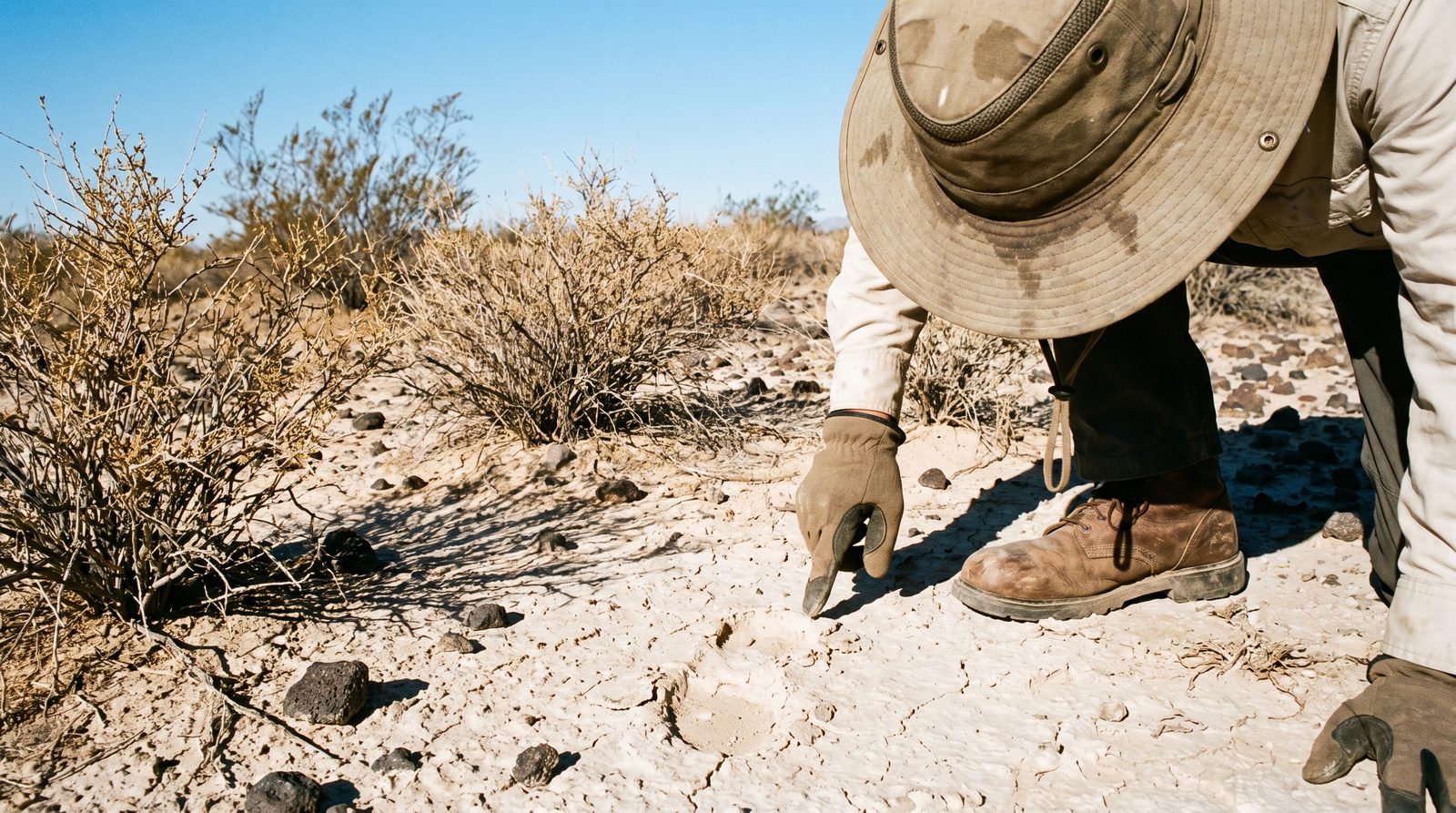
A hasty team moves fast along the highest probability routes, the trail itself, the drainages, looking for the obvious. Speed matters more than thoroughness at this stage, because the whole thing is a race against dehydration.
Grid searching, where a line of people walks slowly shoulder to shoulder, is slow and expensive and is used late or in small areas, not first.
Dogs work differently depending on type. An air scenting dog works a large area looking for any human scent. A trailing dog works a specific person's scent from a starting article. Both are affected badly by heat and by wind, and in this country the middle of the day is largely useless for them.
The desert specifics
Heat is the clock. In summer the survival window is measured in hours, not days, and a search that would be a two day operation in a temperate climate has to be resolved before the following afternoon.
Water is the whole problem. People carry too little and then ration it, which is the wrong instinct. Dehydrated judgement is bad judgement, and a great many of the fatal cases involve somebody who made a poor decision several hours before they collapsed.
Terrain lies. A wash looks like a path and it leads away from where you want to be. Distances look shorter than they are.
And at night it gets genuinely cold, which catches out people dressed for the afternoon.
What actually helps them find you
Tell somebody where you are going and when you will be back. This is the single most useful thing and it costs nothing.
Stay put once you know you are lost. Movement expands the search area geometrically, and a stationary subject in a known segment is found much faster.
Make yourself visible. Get to open ground, bright clothing outward, anything reflective facing up.
Carry more water than you think, and a whistle, which carries further than a voice and does not wear out.
The volunteers
They are unpaid. They have jobs. They keep a bag by the door and they leave in the middle of the night when the pager goes.
I have been on a couple of these as a reporter and what strikes you is how unemotional it is at the command post. Grids, radios, coffee, somebody updating a map.
The emotion is elsewhere, with the family in a car at the trailhead, and the volunteers know exactly where it is. That is why they are so careful to be boring about the process.