The mechanics who keep ancient school buses running on dirt roads
The bus that collects children on the county roads east of here was built in 2004. It has something over three hundred thousand miles on it and it will be running next year, because there is no money to replace it and there is a man in a shop who will not let it die.
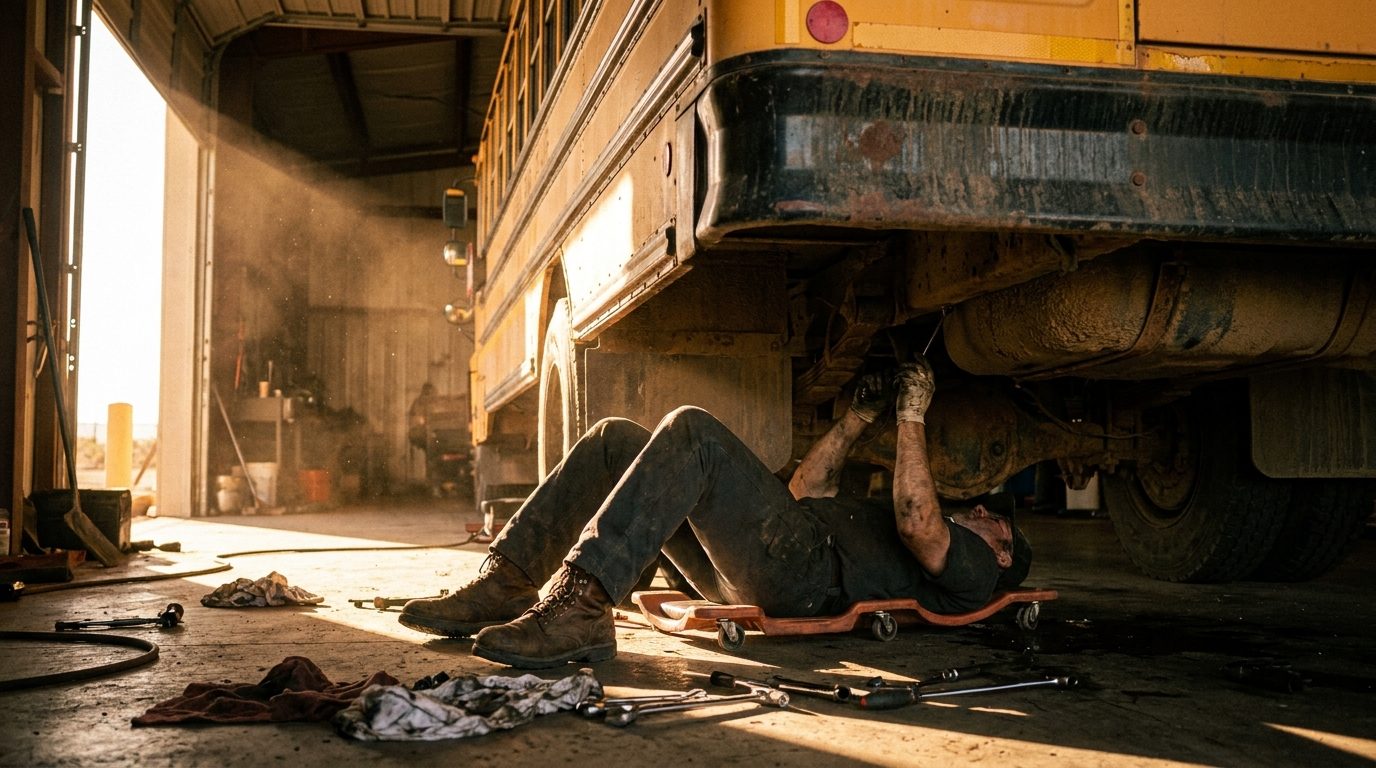
I spent a morning in that shop.
Why the buses are old
A new school bus is a substantial purchase, and rural districts with small tax bases and falling enrolment do not make substantial purchases often.
Grant programmes exist, including federal funding aimed at replacing older diesel buses with cleaner ones, and they are competitive and they do not cover every district.
So the fleet ages. Fifteen years is common. Twenty is not unusual.
Meanwhile the routes here are long. A rural route can be sixty or seventy miles in a morning, much of it on graded dirt, which is the hardest surface a vehicle can work on short of no surface at all.
What dirt does to a bus
Dust gets into everything. Air filters clog at a rate that would seem absurd to a city fleet. The mechanic I spoke to changes them on a schedule based on his own experience rather than the manufacturer's, which assumes pavement.
Washboard road surfaces shake everything apart. Brackets crack. Wiring chafes. Exhaust hangers fail. Anything that is bolted works loose and anything that is welded eventually cracks.
Suspension takes the worst of it. Springs, shackles, bushings, shock absorbers. He said he replaces components on these buses at three or four times the interval a paved route would produce.
Brakes wear on the descents and glaze on the long flat runs.
And the corrugated surface breeds a specific failure he described as the thing that finds every weak weld on the vehicle.
The parts problem
For a twenty year old bus, some parts are no longer made.
He showed me a shelf of components pulled from a bus that was retired four years ago and kept as a donor. That is the actual strategy in a lot of rural districts: keep the corpse.
Beyond that it is aftermarket suppliers, salvage yards, and fabrication. He makes brackets. He has a welder and he uses it constantly.
He was careful to distinguish between what he will fabricate and what he will not. Brackets, mounts, exhaust hangers, yes. Anything in the brake system, the steering, or the structure that protects the passenger compartment, no. Those get correct parts or the bus does not go out.
The inspections
School buses are inspected on a schedule set by the state, and the standards are not relaxed because a district is poor.
He seemed to regard this as entirely correct and also as the source of most of his stress, because an inspection failure takes a bus off the road and there is no spare.
That is the real constraint. A district with six buses and six routes has no margin. One vehicle down is children not collected.
The man
Twenty-six years in the job. He could earn considerably more at a commercial fleet in the city, which he mentioned once and did not dwell on.
He knows the drivers, and the drivers know the children, and he made a point about that which I have been thinking about since. He said he does not work on buses, he works on the thing that gets forty children to school, and those are different jobs when you are deciding whether something can wait until Monday.
What it would take to fix
More money, obviously, and more of the grant programmes reaching small districts rather than the ones with grant writers on staff.
Also, and he raised this himself, apprentices. He is fifty-eight. There is nobody behind him in that shop, and the skills he has are specific to keeping old diesel equipment alive, which is not what training programmes teach any more.
When he retires, the district will contract the work out at commercial rates, and the arithmetic that has kept those buses running for twenty years will stop working.